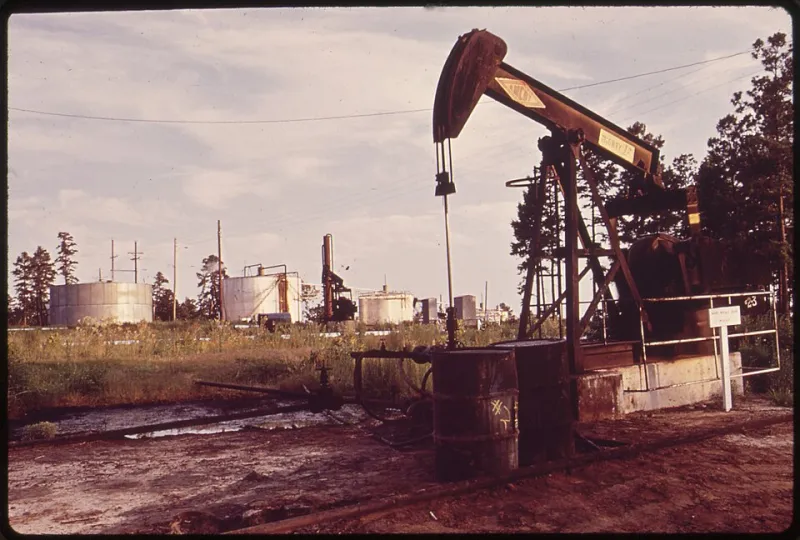
Everything but the Oil: Helium, Lithium, and the Bakken's Accidental Second Revenue Stream
Photo: Post of the Soviet Union (N. E. Kruglov)., Public domain, via Wikimedia Commons
For a century, the oil industry's accounting has been brutally simple: hydrocarbons in, money out; everything else, a cost. Produced water was disposal expense. Gas streams without a market were flared or vented. Brine was somebody's problem.
That accounting is starting to change, and the Bakken may be one of the biggest beneficiaries.
The Chemistry Nobody Budgeted For
The same geological history that filled the Bakken's source rocks with oil also concentrated a periodic table's worth of dissolved elements in its formation waters. Lithium salts ride in produced brine at concentrations that, at scale, rival some conventional brine operations. Helium—the finite, strategically critical gas that lifts everything from MRI magnets to semiconductor manufacturing—appears in nitrogen-rich and hydrocarbon gas streams that operators previously never thought to assay.
The technology gap is closing fast. Direct lithium extraction technologies, membrane separation, and modular gas processing are shrinking the physical and economic footprint required to pull value from these streams. What once demanded a refinery-scale installation can increasingly fit on a well pad.
Early Movers and What They're Doing Differently
The operators taking this seriously share a few habits. They assay everything—compositional analysis of water and gas is now a due-diligence step, not an afterthought. They negotiate mineral and byproduct rights with an eye toward future streams, because a lease drafted in 2010 never contemplated a lithium revenue line. And they treat pilot projects as learning capital, accepting modest early returns to build data and processing know-how before the market matures.
Service firms have a parallel opportunity. Sampling, water treatment, and modular processing are natural extensions of existing produced-water businesses—the very infrastructure built for compliance can become the backbone of extraction.
What Royalty Holders Should Watch
Royalty owners have the most to gain and the most to lose here. Byproduct revenue could meaningfully supplement hydrocarbon payments—but only if the language of existing agreements contemplates it. Holders reviewing leases should be asking pointed questions: Are non-hydrocarbon streams covered? How is byproduct value calculated? Who bears the cost of processing versus claiming the upside?
A Portfolio, Not a Lottery Ticket
The honest assessment: none of these markets will replace oil revenue in this decade. Helium demand is real but niche; lithium pricing is volatile; extraction economics remain sensitive to concentration and scale. The operators who win won't be the ones betting the company on brine—they'll be the ones converting a disposal line item into an option on the future, one pilot at a time.
The Bakken's next act may not be a new play at all. It may be the old play, read more carefully.