Beyond the Lease Agreement: Why Community Trust Is Now a Measurable Competitive Asset in the Bakken
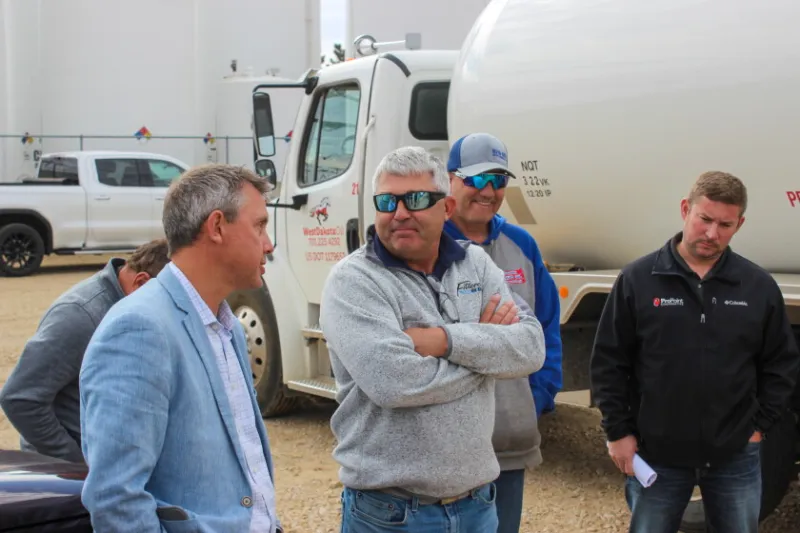
Photo: oil company representative talking with rural landowner North Dakota community meeting, via cdn.forumcomm.com
For decades, the dominant variables in Bakken project economics were geological and financial: porosity, permeability, breakeven price, and capital allocation. These remain essential. But a quieter variable has been accumulating influence—one that rarely appears on a project scorecard yet consistently shapes whether a well pad moves forward on schedule, whether a permit clears without challenge, and whether an operator can recruit and retain the local workforce it needs to function. That variable is community trust.
Leading operators in the Williston Basin are no longer treating stakeholder engagement as a regulatory formality. They are systematizing it, resourcing it, and measuring it the same way they measure drilling performance. The results are beginning to separate the field.
The Hidden Costs of Neglected Relationships
The economic consequences of poor community relations are rarely itemized in project post-mortems, which is precisely why they persist. A permit delayed by a neighboring landowner's unresolved complaint does not show up as a line item—it shows up as a production start date that quietly slips by six weeks. A county commission that feels bypassed on a road use agreement does not formally obstruct operations—it simply becomes slower to process requests, less cooperative on variance applications, and less inclined to resolve disputes in the operator's favor.
Multiply these friction points across a multi-well development program and the cumulative drag on project economics becomes significant. Industry observers in North Dakota have noted that operators with poor local reputations routinely face longer permitting timelines, higher legal and mediation costs, and elevated employee turnover in field positions—each of which compounds the others.
Conversely, operators who have invested in structured community engagement programs report measurably faster project progression, fewer formal complaints filed with state regulators, and stronger relationships with county governments that translate into practical cooperation on infrastructure, zoning, and emergency response coordination.
From Compliance to Strategy
The distinction between operators who treat community relations as compliance overhead and those who treat it as a core business function is visible in how each group structures its internal operations.
Compliance-oriented operators typically assign community engagement responsibilities to legal or regulatory affairs departments. Interactions with landowners and municipalities are transactional, initiated when a specific permit or agreement requires it, and managed to closure as quickly as possible. The goal is to satisfy the minimum requirement and move on.
Strategy-oriented operators take a fundamentally different approach. They assign dedicated community affairs personnel who are embedded in specific geographic areas, maintain ongoing relationships with landowners regardless of whether active development is imminent, and participate in local civic life—attending county events, supporting local emergency services, and engaging with school districts—before any immediate business need arises.
This proactive posture changes the dynamic considerably. When an operator who has been a consistent, visible community presence for two years brings a new development proposal to a county commission, the conversation begins from a foundation of established credibility. When an operator who has never engaged locally arrives with the same proposal, it begins from a foundation of suspicion.
Systematizing Engagement: What Leading Operators Are Doing
Several practices are emerging among operators who have elevated community relations to a strategic priority.
Landowner communication protocols: Rather than limiting contact to lease negotiation and occasional operational notices, leading operators maintain scheduled, proactive communication with landowners throughout the development lifecycle. This includes advance notification of activity changes, direct access to a named company contact, and structured processes for receiving and responding to concerns—often within defined timeframes that are communicated to landowners upfront.
Municipal partnership frameworks: Operators with significant activity in specific counties are increasingly formalizing their relationships with local governments through road use and maintenance agreements that go beyond the legal minimum, voluntary contributions to local infrastructure funds, and regular briefings to county commissioners on operational plans and timelines. These arrangements create goodwill while also establishing clear mutual expectations that reduce the likelihood of disputes.
Local hiring and procurement commitments: Employment and purchasing decisions that favor local communities generate tangible economic benefit that residents and officials recognize. Operators who can point to specific hiring numbers, vendor relationships with local businesses, and apprenticeship programs tied to regional trade schools are building a stakeholder base with a direct financial interest in the operator's continued success.
Community advisory structures: A small but growing number of Bakken operators have established informal community advisory groups—drawing from landowners, local officials, and civic representatives—that meet periodically to review operational plans and provide feedback. While these groups carry no formal authority, they serve as early warning systems for emerging concerns and signal a level of transparency that builds durable trust.
The Regulatory Dimension
North Dakota's regulatory environment for oil and gas development, while generally supportive of industry activity, is not immune to community pressure. State agencies receive formal complaints from landowners and municipalities, and operators with histories of unresolved disputes face heightened scrutiny during permit reviews. In an era when environmental and land use concerns are receiving increasing public attention, the reputational posture an operator maintains in its operating communities has direct bearing on its regulatory experience.
Operators who have cultivated strong local relationships also tend to have better intelligence about potential regulatory developments before they crystallize. County officials who trust an operator are more likely to give informal advance notice of concerns that could eventually become regulatory challenges—providing the operator time to address issues proactively rather than reactively.
Measuring What Matters
One of the more sophisticated shifts occurring among leading operators is the effort to make community relations performance measurable. This remains an emerging practice, but several approaches are gaining traction: tracking permit processing times as a proxy for regulatory relationship quality, monitoring the frequency and nature of formal complaints filed with state agencies, surveying landowners on satisfaction with communication and responsiveness, and tracking local hiring and procurement metrics against stated commitments.
When community relations performance is measured alongside operational and financial metrics, it becomes visible to leadership and eligible for resource allocation. Operators who have made this shift report that it changes internal conversations about where to invest time and attention—elevating community engagement from a soft function to a quantifiable contributor to project performance.
The Competitive Implication
The Bakken remains a highly competitive operating environment. Operators are competing for acreage, capital, talent, and favorable project economics simultaneously. In that context, any durable source of operational advantage deserves serious attention.
Community trust is not a soft asset. It is a structural advantage that compounds over time, reduces friction across the entire project lifecycle, and is genuinely difficult for competitors to replicate quickly. Operators who have built it over years of consistent, credible engagement are operating with a running start that cannot be purchased or shortcut.
For operators still treating stakeholder management as a box to check, the message from the leaders of this field is unambiguous: the relationship infrastructure is as real as the physical infrastructure, and it is time to start building it deliberately.